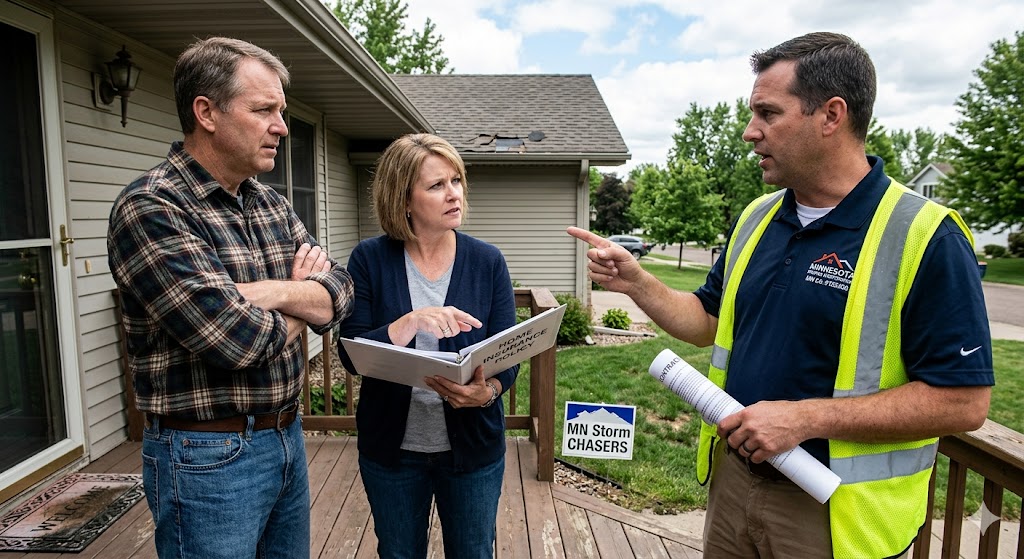
In Minnesota, it is actually illegal for contractors to represent themselves as insurance experts or promise specific coverage outcomes. Here is the hard truth: your contractor has likely never read your specific policy, yet their “promises” often lead to homeowner frustration and financial loss.
The Danger of the “Free Roof” Promise
We’ve all seen it: a storm chaser knocks on your door, offers a free inspection, and says, “You have damage! I can get you a new roof for just the cost of your deductible.”
When a new roof typically costs between $16,000 and $25,000, paying a $1,000 deductible sounds like a steal. But this promise ignores the fine print of your individual policy.
ACV vs. RCV: The Math That Matters
Many modern policies are shifting toward Actual Cash Value (ACV) rather than Replacement Cost Value (RCV). If you have an ACV policy, your insurance company subtracts depreciation based on the age and condition of your roof.
The Reality Check:
Imagine you have a 15-year-old roof with 30-year shingles (50% depreciated) and a $1,000 deductible:
| Item | Cost/Calculation |
| Total Roof Replacement Cost | $20,000 |
| Less Depreciation (50%) | – $10,000 |
| Less Your Deductible | – $1,000 |
| Actual Insurance Payout | $9,000 |
In this scenario, you aren’t paying $1,000—you’re on the hook for $11,000.
The “Storm Chaser” Trap
When the payout comes back lower than promised, some contractors rarely admit they overpromised. Instead, they pivot to blame: “You just have a bad insurance policy.” By then, the damage is done:
- The Claim is Filed: You now have a claim on your record, which can affect your premiums.
- The “One-Shot” Rule: If you don’t use that $9,000 to fix the roof, the insurance company will likely refuse to cover that roof ever again.
- Emotional Exploitation: Contractors often use fear or excitement to cloud a homeowner’s judgment during an already stressful time.
The Bottom Line
Don’t let a contractor’s sales pitch dictate your financial future. Before filing a claim based on a roofer’s “guarantee,” call your insurance agent. They are the only ones qualified—and legally allowed—to tell you what is actually covered.
Protect your home and your wallet: Read your policy before you sign a contract.